
7 Best Online Medical Coding Programs and Courses for 2026 Certification
Educational Investment Benchmarks for 2026
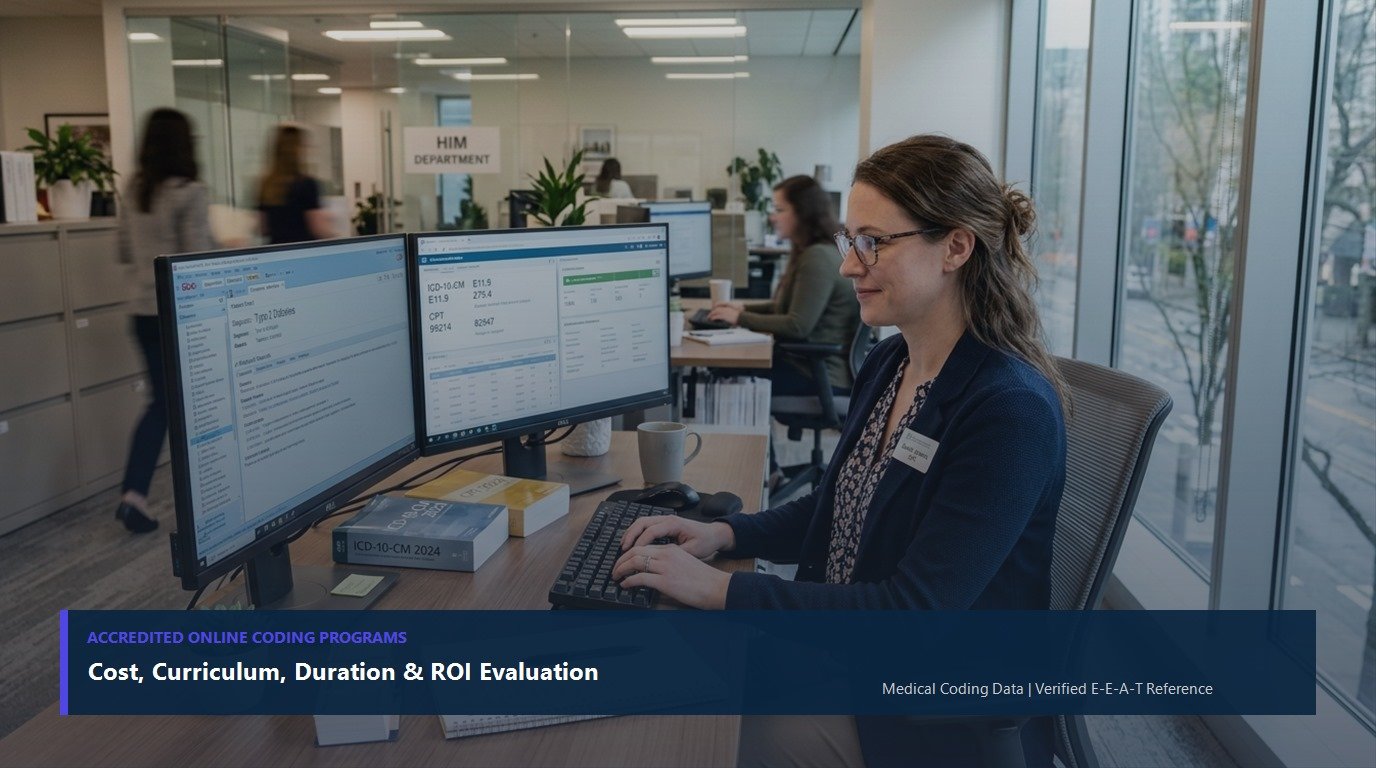
Online medical coding education allows adult learners to transition into healthcare revenue cycle careers without stepping foot on a physical campus. High-quality accredited programs range from $1,800 to $6,500 in total tuition, require 4 to 12 months of study, and boast national credentialing exam pass rates of 78% to 86% (compared to under 30% for unaccredited self-taught candidates). Selecting the right institution is the single most critical financial decision in your career launch.
Introduction: Navigating the Online Medical Coding Educational Landscape
The demand for qualified medical coding professionals has spurred a dramatic expansion in online education. Today, aspiring medical coders can access world-class clinical anatomy lectures, electronic health record (EHR) simulators, and coding case libraries from home. However, the sheer volume of available programs can be overwhelming, and the presence of deceptive, unaccredited diploma mills poses a serious financial risk to prospective students.
Hiring managers, hospital HR directors, and billing supervisors evaluate your educational background with scrutiny. Graduating from a program recognized by the American Academy of Professional Coders (AAPC) or accredited by the Commission on Accreditation for Health Informatics and Information Management Education (CAHIIM) immediately verifies your technical competency. Below is an exhaustive, unbiased evaluation of the top seven online medical coding programs for 2026, analyzed across curriculum rigor, tuition value, credential alignment, and real-world employer reputation.
Key Evaluation Criteria: What Makes a Program Worth Your Investment?
Before examining individual institutions, understanding the standards used to rank these programs will help you make an informed decision based on your specific learning preferences and financial budget:
- Credential Alignment: Does the curriculum prepare you directly for the AAPC Certified Professional Coder (CPC) or AHIMA Certified Coding Specialist (CCS) examination? Programs that issue generic internal certificates without national credential alignment carry virtually zero weight in healthcare hiring queues.
- Codebook and Material Inclusions: Does the tuition package include official, current-year physical codebooks (AMA CPT Professional Edition, ICD-10-CM Expert, and HCPCS Level II Expert), or will you face an unexpected $350 out-of-pocket expense upon enrollment?
- Authentic Chart Abstraction Experience: Does the program force you to read redacted clinical medical records, operative notes, and pathology summaries, or does it rely exclusively on simple multiple-choice quizzes? Clinical chart experience is indispensable for passing national exams.
- Exam Voucher and Practicode Integration: Does the course package include national examination test vouchers (a $450 to $500 value) and access to AAPC Practicode to accelerate apprentice (CPC-A) removal?
- Accreditation and Financial Aid Eligibility: Is the institution accredited by recognized bodies such as CAHIIM, DEAC (Distance Education Accrediting Commission), or regional higher-learning commissions, qualifying students for federal Title IV financial aid (FAFSA / Pell Grants) or state workforce WIOA grants?
The 7 Best Online Medical Coding Programs for 2026
1. AAPC Official Medical Coding Training Course
Target Credential: Certified Professional Coder (CPC)
Estimated Duration: 4 to 8 months (self-paced or instructor-led)
Tuition Range: $2,995 - $3,995 (bundled with books and exam vouchers)
As the governing organization that creates and proctors the CPC examination, AAPC offers the most direct and aligned curriculum available for outpatient physician coding. Their comprehensive online package covers medical terminology, anatomy, pathophysiology, and in-depth CPT, ICD-10-CM, and HCPCS Level II code application.
Key Advantages: AAPC training bundles include the current-year codebook trio, an annual AAPC student membership, two exam attempts, and full enrollment in Practicode, allowing graduates to remove their apprentice (CPC-A) status upon course completion. Instructor-led options feature weekly live video webinars and direct messaging with certified AAPC instructors.
2. AHIMA Medical Coding Professional Certificate Program
Target Credential: Certified Coding Specialist (CCS) / Certified Coding Associate (CCA)
Estimated Duration: 6 to 12 months
Tuition Range: $3,200 - $4,200
For students whose primary career ambition is inpatient hospital facility coding, trauma center abstraction, and DRG reimbursement analysis, the American Health Information Management Association (AHIMA) provides the definitive gold-standard curriculum. The program covers ICD-10-PCS (Procedure Coding System), hospital billing guidelines (UB-04), and acute inpatient documentation review.
Key Advantages: Unrivaled depth in inpatient clinical documentation and hospital prospective payment systems (IPPS). The course thoroughly prepares learners for the challenging CCS examination, which is universally respected by hospital health information management directors.
3. Andrews School Medical Billing and Coding
Target Credential: CPC (AAPC) and CCS (AHIMA)
Estimated Duration: 10 to 14 months
Tuition Range: $4,400 - $5,200
The Andrews School is widely regarded across professional coding forums and LinkedIn HIM communities as one of the most rigorous independent distance-learning institutions in the United States. Unlike accelerated bootcamps, Andrews teaches dual-track curriculum covering both outpatient physician and inpatient facility hospital coding.
Key Advantages: Exceptionally high job placement rates and legendary instructor mentorship. Graduates from Andrews are frequently recruited directly into hospital coding departments because employers recognize the exhaustive chart-abstraction rigor of their graduation standards.
4. Career Step Online Medical Billing and Coding Program
Target Credential: CPC (AAPC) or CCA (AHIMA)
Estimated Duration: 4 to 12 months (self-paced)
Tuition Range: $3,699 - $4,499
Career Step has trained over 100,000 healthcare learners over three decades. Their online curriculum is mobile-responsive, self-paced, and engineered specifically for working adults balancing family and employment commitments. They maintain formal education partnerships with major national health networks.
Key Advantages: Approved provider for the Department of Defense Military Spouse Career Advancement Accounts (MyCAA) program, offering up to $4,000 in tuition assistance for eligible military spouses. The program includes exam preparation modules and national certification test vouchers.
5. Penn Foster Medical Billing and Coding Career Diploma
Target Credential: CPC (AAPC) or CBCS (NHA)
Estimated Duration: 6 to 11 months
Tuition Range: $1,199 - $1,799 (with monthly payment plans)
For prospective students seeking an accessible, affordable entry point into the revenue cycle field without committing thousands of dollars upfront, Penn Foster offers an accredited, low-cost alternative. Their program is accredited by the Distance Education Accrediting Commission (DEAC) and the Council for Higher Education Accreditation (CHEA).
Key Advantages: Extremely budget-friendly monthly installment options starting as low as $59 per month with 0% interest. While students must purchase their own codebooks for the national exam, the low baseline tuition makes it an ideal self-starter option for disciplined independent learners.
6. Hutchinson Community College Online Healthcare Coding Certificate
Target Credential: CCA, CCS, CPC
Estimated Duration: 9 to 12 months (academic semesters)
Tuition Range: $3,800 - $5,800 (in-state vs out-of-state credit rates)
Hutchinson Community College (HutchCC) is an established public institution renowned for its CAHIIM-accredited Health Information Management programs. Students earn formal collegiate academic credits that can be directly applied toward an Associate of Applied Science (AAS) in Health Information Technology.
Key Advantages: Full eligibility for federal Title IV financial aid (FAFSA, Pell Grants, federal student loans). Students receive personalized academic instruction from tenured collegiate faculty and gain access to comprehensive university student services and career fairs.
7. San Juan College Online Medical Insurance Coder Certificate
Target Credential: CPC (AAPC) or CCS (AHIMA)
Estimated Duration: 12 months (2 to 3 semesters)
Tuition Range: $2,800 - $4,600
San Juan College offers a nationally recognized, comprehensive online certificate program covering both professional coding and institutional billing. The curriculum includes intensive medical anatomy, diagnostic coding, procedural coding, reimbursement methodologies, and computer applications in healthcare.
Key Advantages: Exceptionally low tuition rates, particularly for regional and online distance learners, combined with robust collegiate academic accreditation and direct credit articulation into four-year Health Information Management bachelor programs.
Comprehensive Master Comparison Matrix
Compare key structural metrics across all seven premier online medical coding programs:
| Institution | Credential Focus | Tuition Cost | Typical Duration | Codebooks Included? | Financial Aid / Assistance |
|---|---|---|---|---|---|
| AAPC Official Training | CPC | $2,995 - $3,995 | 4 - 8 months | Yes (in select bundles) | Affirm financing, PayPal Credit |
| AHIMA Certificate | CCS / CCA | $3,200 - $4,200 | 6 - 12 months | Optional add-on | AHIMA Foundation scholarships |
| Andrews School | CPC + CCS (Dual) | $4,400 - $5,200 | 10 - 14 months | Yes | Internal 0% payment plans |
| Career Step | CPC / CCA | $3,699 - $4,499 | 4 - 12 months | Yes | MyCAA (Military), WIOA, monthly terms |
| Penn Foster | CPC / CBCS | $1,199 - $1,799 | 6 - 11 months | No (purchased separately) | Monthly installments ($59/month) |
| Hutchinson CC | CCA / CCS / CPC | $3,800 - $5,800 | 9 - 12 months | Purchased via bookstore | Federal FAFSA, Pell Grants, State aid |
| San Juan College | CPC / CCS | $2,800 - $4,600 | 12 months | Purchased via bookstore | FAFSA, Institutional scholarships |
Understanding Accreditation: CAHIIM vs Proprietary Approval
Navigating educational accreditations is vital to ensure your tuition dollars result in meaningful career credentials:
Accreditation Distinctions Explained
CAHIIM Accreditation: The Commission on Accreditation for Health Informatics and Information Management Education is the premier programmatic accreditor recognized by the Council for Higher Education Accreditation (CHEA). Graduating from a CAHIIM-accredited collegiate program qualifies you to sit for the Registered Health Information Technician (RHIT) credential.
AAPC Approved Education Partner: Proprietary coding schools and vocational providers holding AAPC approved status utilize official AAPC curriculum materials, licensed slide decks, and genuine practice examinations. While they do not grant collegiate degrees, they provide optimal targeted prep for the CPC examination.
How to Pay for Your Medical Coding Education
If paying out-of-pocket tuition upfront is a hurdle, evaluate these legitimate financial assistance avenues:
- WIOA Grants (Workforce Innovation and Opportunity Act): Federal workforce funding administered through state American Job Centers. Unemployed, underemployed, or displaced workers can frequently secure 100% tuition coverage for approved medical coding vocational programs.
- MyCAA Military Spouse Scholarships: Provides up to $4,000 of tuition assistance for eligible spouses of active-duty service members pursuing healthcare licenses and credentials.
- Employer Tuition Assistance: If you currently work in a hospital or clinic setting (even in reception, dietary, or environmental services), many healthcare employers offer annual tuition reimbursement between $2,000 and $5,250 for employees advancing into revenue cycle roles.
Frequently Asked Questions About Online Medical Coding Programs
Can I complete an online medical coding program while working full-time?
Yes. The vast majority of online medical coding students maintain full-time jobs. Programs such as AAPC On-Demand, Career Step, and Penn Foster offer self-paced scheduling, allowing you to watch lectures, complete readings, and practice coding cases during evenings and weekends.
Are online medical coding certificates respected by hospitals?
Yes. Healthcare employers evaluate your national credential (such as the AAPC CPC or AHIMA CCS) rather than whether your coursework was delivered in a traditional classroom or over the internet. What matters to hiring managers is your ability to pass technical coding assessments and audit examinations during the interview process.
What computer equipment do I need for online coding courses?
You need a reliable computer (Windows 10/11 or macOS) with high-speed internet, a modern web browser (Chrome, Edge, or Firefox), and a webcam with a microphone. While smartphones and tablets work for reading study materials, practicing with full-scale electronic codebooks, EHR simulators, and proctored exam portals requires a desktop or laptop computer.
How many hours a week should I study?
Plan to commit 10 to 15 hours per week for steady progress. Accelerated learners who dedicate 20 to 25 hours weekly can finish comprehensive training and sit for their certification exam in under 4 months.
Ready to Pass Your AAPC CPC Exam on the First Attempt?
Master all 17 examination domains with the Complete CPC Exam Blueprint Course. Includes 12 high-yield video modules, 6 timed mock exams, physical codebook tabbing maps, and a 30-day money-back guarantee.
Medical Coding Data Editorial Research Team
Our editorial board consists of AAPC and AHIMA credentialed coding instructors, certified professional coders (CPC), certified inpatient coders (CIC), and clinical documentation specialists with over 35 combined years of revenue cycle and clinical auditing experience. All guidelines are verified against official releases from CMS, CDC, and the AMA.