
How to Become a Medical Coder with Zero Experience: 6-Step Career Roadmap
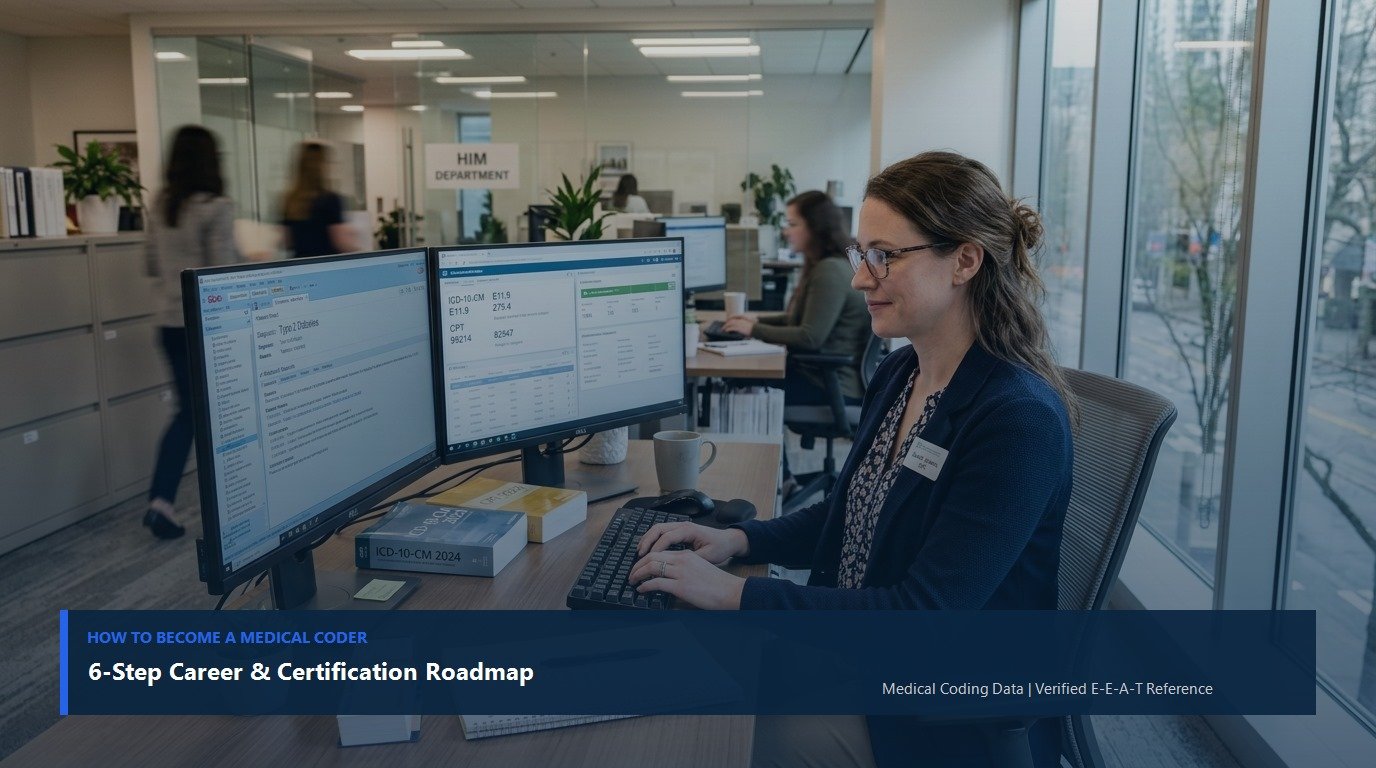
Career Launch Summary for 2026-2027
Entering the medical coding profession requires no prior clinical background or four-year university degree. By mastering foundational medical sciences, completing targeted codebook training, and earning an industry-recognized credential such as the Certified Professional Coder (CPC), candidates routinely transition into healthcare revenue cycle positions within 4 to 9 months. Projected job growth remains strong at 8% through 2034, with median starting salaries ranging from $42,000 to $48,500.
Introduction: Why Medical Coding Is Healthcare’s Premier Non-Clinical Career
The modern healthcare ecosystem generates billions of patient encounters annually across hospitals, outpatient surgical centers, physician practices, and telehealth platforms. Every clinical diagnosis, diagnostic ultrasound, surgical excision, and evaluation visit must be translated into standardized alphanumeric codes. This critical translation enables electronic healthcare claims processing, national epidemiological tracking, and regulatory compliance.
Because medical coders work primarily with electronic health records (EHRs), encoder software, and clinical documentation rather than direct patient care, it represents one of the most accessible non-clinical pathways in healthcare. Furthermore, medical coding offers rapid qualification timelines, competitive entry-level wages, comprehensive employer benefits, and genuine pathways toward long-term remote employment.
However, breaking into the field with zero prior healthcare experience requires a structured, strategic approach. Hiring managers seek candidates who demonstrate rigorous diagnostic sequencing precision, deep familiarity with official coding conventions, and verifiable professional credentials. Below is the comprehensive, step-by-step roadmap to transitioning from complete beginner to certified, employed medical coding professional.
Step 1: Master the Core Clinical Prerequisites
Many aspiring coders make the mistake of purchasing expensive codebooks immediately without establishing their clinical vocabulary. Medical coding is not simple data entry. It is clinical documentation analysis. When an operative report describes a “laparoscopic cholecystectomy converted to open laparotomy due to acute gangrenous cholecystitis with choledocholithiasis,” a coder must immediately recognize anatomical landmarks, surgical techniques, and pathological conditions.
Before touching a coding manual, you must achieve working proficiency in four foundational subjects:
- Medical Terminology: Understanding Greek and Latin prefixes, root words, and suffixes. You will learn to decipher complex clinical terms instantly (for example, understanding that “nephro” refers to kidneys, “lith” to stones, and “iasis” to a pathological condition).
- Human Anatomy and Physiology: Detailed comprehension of all eleven bodily organ systems, musculoskeletal structures, vascular pathways, and nerve distributions. Knowing precise arterial branches and skeletal landmarks is essential for procedural coding.
- Human Pathophysiology: The biological mechanisms of disease, clinical progression, systemic manifestations, and standard pharmacological treatments associated with chronic and acute illnesses.
- Healthcare Compliance and Federal Regulations: Essential privacy laws, including the Health Insurance Portability and Accountability Act (HIPAA), Health Information Technology for Economic and Clinical Health (HITECH) Act, False Claims Act, and standard fraud and abuse guidelines enforced by the Office of Inspector General (OIG).
Prerequisite Recommendation
Most community colleges and online educational providers offer bundled prerequisite packages in Medical Terminology and Anatomy. Dedicating 4 to 8 weeks to master these core sciences will dramatically increase your first-time passing score on credentialing exams.
Step 2: Select Your Professional Credential Pathway
In the United States, two primary credentialing bodies govern the professional health information management and medical coding industry: the American Academy of Professional Coders (AAPC) and the American Health Information Management Association (AHIMA). Choosing the right initial credential depends on whether your career goals center on physician practice coding or inpatient hospital facility coding.
| Credential | Governing Body | Primary Focus Setting | Exam Format | Best For |
|---|---|---|---|---|
| Certified Professional Coder (CPC) | AAPC | Physician offices, outpatient clinics, specialty practices | 100 questions, 4 hours | Beginners seeking the most versatile outpatient credential |
| Certified Coding Specialist (CCS) | AHIMA | Hospital inpatient facilities, acute care, trauma centers | 115-140 questions, 4 hours | Candidates focused on complex inpatient ICD-10-PCS and MS-DRG assignment |
| Certified Coding Associate (CCA) | AHIMA | General entry-level inpatient and outpatient coding | 105 questions, 2 hours | Entry-level validation across broad health information topics |
| Certified Inpatient Coder (CIC) | AAPC | Inpatient hospital facilities and health systems | 100 questions, 4 hours | Inpatient facility specialists targeting AAPC hospital roles |
For individuals starting with zero healthcare experience, the AAPC Certified Professional Coder (CPC) credential remains the gold standard. Approximately 70% of medical coding job listings specify or prefer the CPC, making it the most practical and widely recognized entry credential in the nation.
Step 3: Complete an Accredited Medical Coding Training Program
While federal law does not legally require an educational diploma to sit for certification exams, attempting the CPC or CCS exam without formal training yields a failure rate above 70%. Professional coding examinations test intricate cross-referencing between diagnostic tabular lists, procedural modifier rules, and complex CMS reimbursement guidelines.
Prospective coders can choose between four distinct educational delivery models:
| Training Pathway | Estimated Duration | Tuition Cost | Accreditation / Alignment | Primary Advantage |
|---|---|---|---|---|
| Self-Paced Online Academy | 4 to 6 months | $2,200 - $3,800 | AAPC or AHIMA Approved | Maximum flexibility for working adults; cost-efficient |
| Community College Certificate | 9 to 12 months | $3,500 - $6,500 | Regional / CAHIIM | Structured instructor feedback, federal financial aid eligibility |
| Vocational Bootcamp | 3 to 4 months | $4,000 - $7,500 | Proprietary / Industry Partner | Accelerated completion timeline for full-time learners |
| Associate Degree in HIM | 20 to 24 months | $8,000 - $16,000 | CAHIIM Accredited | Qualifies for RHIT credential and future management roles |
When evaluating programs, ensure the curriculum includes practical coding case studies using authentic de-identified medical charts. Theoretical multiple-choice questions alone will not prepare you for production coding requirements.
Step 4: Acquire and Tab Your Official Codebooks
Medical coding certification examinations are open-book, but only specific, approved annual editions are permitted inside testing centers or on webcam proctored feeds. You will need the current calendar year versions of the three core manuals:
- AMA CPT Professional Edition: The American Medical Association’s official procedural codebook. Only the spiral-bound Professional Edition is accepted by AAPC testing proctors.
- ICD-10-CM Expert for Physicians or Hospitals: The International Classification of Diseases, Tenth Revision, Clinical Modification codebook containing Alphabetic Index, Tabular List, Neoplasm Table, and Official Guidelines for Coding and Reporting.
- HCPCS Level II Expert: The Healthcare Common Procedure Coding System manual containing national codes for durable medical equipment, injectable pharmaceuticals, supplies, and temporary national codes (A-codes through V-codes).
Once you receive your manuals, invest dedicated time into tabbing and annotating your books. Highlighting key instructional notes (such as “Code First,” “Use Additional Code,” and “Excludes1” conventions) and installing laminated index tabs allows you to locate obscure anatomical subheadings within seconds during timed examinations.
Step 5: Pass the Exam and Remove the Apprentice Designation (CPC-A)
Upon passing the AAPC CPC examination with a score of 70% or higher, candidates who have fewer than two years of on-the-job coding experience receive the credential with an “Apprentice” status, designated as CPC-A. This designation indicates to employers that you have demonstrated technical mastery of coding principles but have not yet logged two full calendar years of institutional production coding.
Removing the apprentice designation transforms your resume and unlocks access to high-volume hiring pools. You can eliminate the CPC-A designation quickly through verified educational credits:
The 2-Year Apprentice Removal Formula
AAPC allows candidates to waive both years of the required on-the-job experience using the following structured combination:
- Credit Year 1: Complete an approved 80-hour medical coding education course (community college certificate or approved online training academy).
- Credit Year 2: Complete AAPC Practicode, an online real-world simulation program comprising 80 authentic clinical encounters across multiple medical specialties.
By completing this combination, you can transition from CPC-A to full CPC credentialing without waiting two years in a junior billing clerk role.
Step 6: Land Your First Healthcare Role with Strategic Job Hunting
While seasoned remote medical coding positions often request 2 to 3 years of prior production experience, numerous healthcare organizations hire newly certified coders into entry-level positions designed to build operational experience. Consider these high-yield transition roles:
- Payment Posting and Claims Resolution Specialist: Reviewing explanation of benefits (EOB) statements, posting contractual payer adjustments, and identifying initial claim rejections.
- Prior Authorization Specialist: Submitting clinical notes to insurance payers to secure coverage approval for planned surgical procedures and advanced imaging.
- Patient Access and Demographic Registrar: Verifying patient insurance eligibility, gathering clinical intake data, and ensuring accurate guarantor information in hospital registration departments.
- HIM Scanning and Medical Records Technician: Auditing electronic document management queues, managing release of information (ROI) requests, and reviewing clinical chart completion.
Within 6 to 12 months of stellar performance in any of these revenue cycle departments, internal transfers into full-time coding roles are standard procedure for healthcare systems across the country.
A Day in the Life of a New Medical Coder
To understand what daily operations look like once you secure your first position, consider the typical workflow of an outpatient facility medical coder:
Daily Operational Timeline
8:00 AM - Electronic Workqueue Triage: Log into the EHR system (such as Epic, Cerner, or Athenahealth). Review the daily coding queue, which might consist of 35 to 50 outpatient clinical encounters, emergency department visits, or same-day surgery cases.
9:30 AM - Chart Abstraction and Guideline Analysis: Open clinical documentation for an outpatient encounter. Read physician progress notes, review pathology findings, verify diagnostic laboratory panels, and abstract primary and secondary diagnoses following official ICD-10-CM Section IV outpatient conventions.
11:30 AM - Procedural Coding and Modifier Application: Assign appropriate CPT procedure codes for diagnostic endoscopy, minor office excisions, or routine clinical services. Check National Correct Coding Initiative (NCCI) procedure-to-procedure (PTP) edits to determine whether modifier 25 or 59 is clinically justified.
2:00 PM - Physician Query Generation: When clinical documentation contains conflicting, ambiguous, or incomplete statements (such as a documented surgical specimen without a corresponding operative technique), submit an electronic physician query following compliant AHIMA and ACDIS query standards.
4:00 PM - Claim Scrubbing and Clearinghouse Validation: Submit finalized coded charts to the billing clearinghouse. Correct front-end formatting edits, verify diagnosis pointers on CMS-1500 or UB-04 claim forms, and close out daily productivity metrics.
Common Mistakes to Avoid When Starting Your Career
Thousands of candidates begin medical coding education each year, but those who encounter frustrating roadblocks often commit one of three preventable errors:
- Skipping Coding Guidelines in Favor of the Index: You cannot code directly from the Alphabetic Index. Every prospective coder must read the instructional notes, tabular conventions, and exclusion instructions. Relying solely on index searches leads to severe coding inaccuracies and failed certification attempts.
- Ignoring Local Chapter Networking: Both AAPC and AHIMA maintain hundreds of local regional chapters. Attending monthly local chapter meetings (held both in-person and virtually) puts you in direct contact with local healthcare clinic managers, billing supervisors, and lead coding auditors who frequently recruit talent before publicly posting job requisitions.
- Expecting 100% Remote Work on Day One: While experienced medical coders enjoy widespread remote flexibility, many entry-level positions require an initial 30 to 90-day on-site onboarding period. Demonstrating reliability, rapid productivity, and 95%+ audit accuracy during initial training will accelerate your approval for permanent work-from-home privileges.
Frequently Asked Questions About Becoming a Medical Coder
Can I become a medical coder without a college degree?
Yes. A high school diploma or GED equivalent is the only formal educational requirement needed to sit for national certification exams such as the AAPC CPC. Employers prioritize verified certification, coding accuracy, and proficiency with healthcare software over a four-year college degree.
How much does it cost to get certified as a medical coder?
Total investment typically ranges between $2,500 and $4,500. This includes an approved online training course ($1,800 to $2,800), official annual codebooks ($250 to $350), AAPC student membership ($140), and the CPC examination fee ($350 to $450, which usually includes one free retake attempt).
Is medical coding difficult to learn?
Medical coding requires intense attention to detail, analytical reading skills, and disciplined memorization of medical terminology. While the volume of codes is extensive (over 70,000 ICD-10-CM codes alone), you do not need to memorize every number. Instead, you learn how to navigate official codebook guidelines, utilize electronic encoders, and apply clinical logic efficiently.
How long does it take from start to finish?
Full-time students dedicating 20 to 30 hours per week typically complete prerequisites, training, and exam preparation in 4 to 6 months. Part-time students working full-time jobs generally complete their credentialing within 8 to 12 months.
Will AI replace medical coders in the future?
Artificial intelligence and autonomous computer-assisted coding (CAC) tools assist coders by suggesting initial codes from digital text. However, AI cannot replace the clinical judgment, complex operative report synthesis, physician query compliance, and payer audit defense performed by skilled human medical coding professionals. The role is evolving from manual data lookup into advanced documentation auditing and revenue integrity validation.
Ready to Pass Your AAPC CPC Exam on the First Attempt?
Master all 17 examination domains with the Complete CPC Exam Blueprint Course. Includes 12 high-yield video modules, 6 timed mock exams, physical codebook tabbing maps, and a 30-day money-back guarantee.
Medical Coding Data Editorial Research Team
Our editorial board consists of AAPC and AHIMA credentialed coding instructors, certified professional coders (CPC), certified inpatient coders (CIC), and clinical documentation specialists with over 35 combined years of revenue cycle and clinical auditing experience. All guidelines are verified against official releases from CMS, CDC, and the AMA.